Intensifying livestock farming may reduce foraging opportunities for an obligate scavenger
Abstract
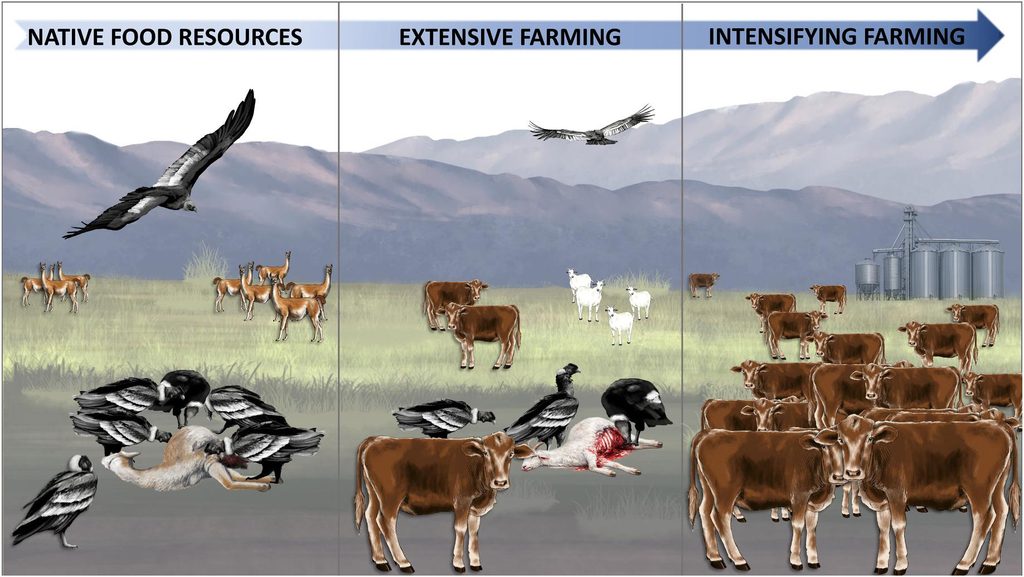
Growing demand for meat is increasing livestock production, which could boost carrion resources for threatened scavenger species. This potential benefit, however, can be offset by the intensification of livestock farming, where higher livestock densities are generally accompanied by carcass removal to prevent problems associated with decomposition. In northern Patagonia, the decline of native ungulates and the expansion of livestock have made Andean condors (Vultur gryphus) highly dependent on domestic species. Here, we evaluated how Andean condor feeding locations relate to livestock density across different farming systems. We identified 1854 potential feeding events from GPS data of 27 Andean condors tracked between 2011 and 2018 and analyzed habitat selection using a matched case–control design. Andean condors avoided feeding where livestock densities were highest. However, within landscapes dominated by extensive farming, their feeding events were positively related with livestock density. In both contexts, thermal uplift also strongly influenced Andean condor feeding space use. Our results suggest that livestock density alone may not reliably indicate carrion accessibility for Andean condors, highlighting the need to assess how different production systems affect food resources for this species. As livestock production intensifies globally, associated management practices may have unintended consequences for scavenger conservation and the ecosystem services they provide.
Información
2026
Artículo
local_offer Líneas de acción