Zenith placement of camera traps can individually identify the güiña Leopardus guigna: implications for population studies and conservation
Abstract
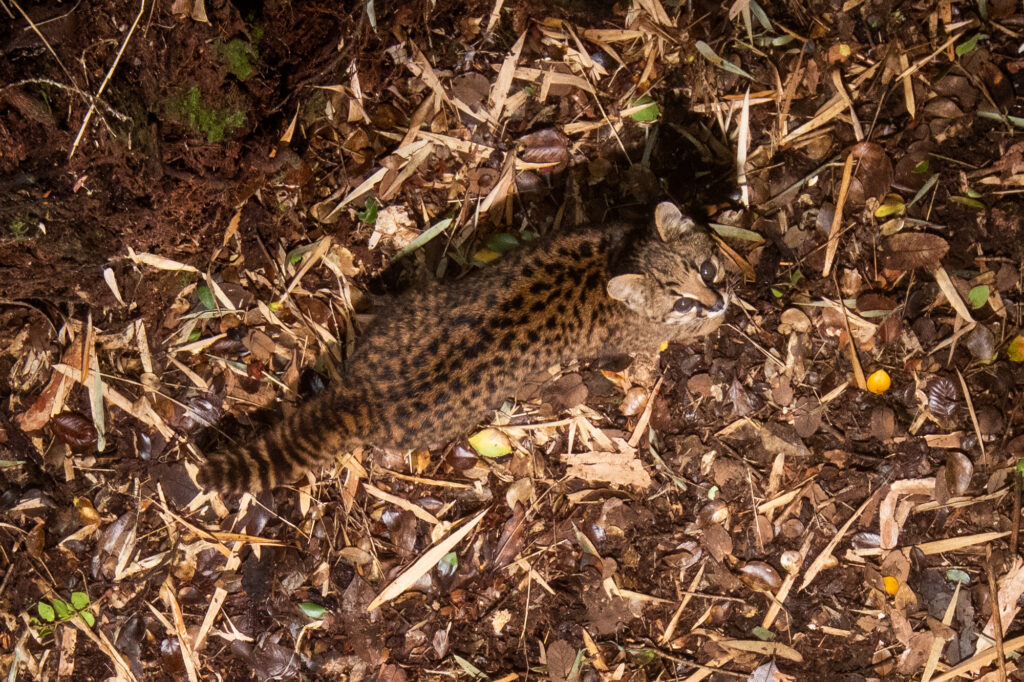
Population estimates of abundance and density are key metrics to evaluate the conservation status of wild felids and inform conservation actions. Individual identification of wild felids with camera traps has been carried out mostly for large and conspicuous species. Small, subtly marked species have received significantly less research attention. One such species is the güiña Leopardus guigna, the smallest wild cat of the Neotropics. The species is categorized as Least Concern on the IUCN Red List, but some subpopulations are threatened. To our knowledge, there have been no studies to estimate güiña population density or abundance from individual identification. Commonly, camera traps are set up horizontally, to face the flanks of a passing animal, with one or more cameras per site for individual identification. However, in güiñas the dorsal zone has more notable and highly individual variation in spotted markings than the flanks. To identify güiña individuals in the temperate rainforest of Chilean Patagonia based on their dorsal markings, we carried out a camera-trap survey with zenith orientation (i.e. cameras oriented vertically, facing downwards). During 12,784 trap-days, we captured 1,386 photographs of güiñas in 586 independent events. We successfully identified 12 individuals. Our results show that zenith camera-trap placement can facilitate individual identification of subtly marked species such as the güiña. We provide recommendations for zenith installation of camera traps and for the identification process. We discuss the potential application of this method for population density estimates of güiñas and other small wild cat species with similar dorsal markings.
Información
2026
Artículo
Oryx - The International Journal of Conservation, Cambridge University Presslaunch
local_offer Líneas de acción