“We are responsible for deciding how we, as farmers, influence political decisions”: adaptation practices to droughts by small-scale farmers in a globally important South American Archipelago
Abstract
Introduction:
In the current context of global environmental change, small-scale farming systems are being negatively affected by various social-ecological change processes, including climate variability, the occurrence of extreme events, and other anthropogenic pressures. In these circumstances, droughts represent one of the main challenges for small-scale farmers, as they directly affect their production, farming systems, and livelihoods.
Methods:
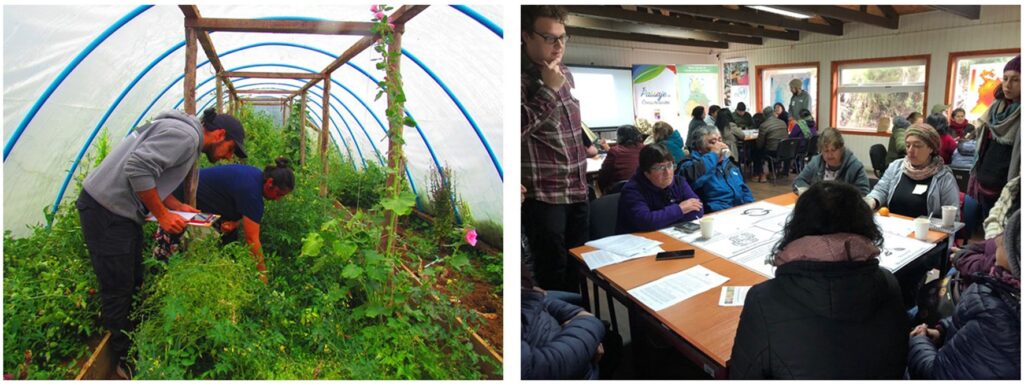
Through a qualitative approach, we identified the main adaptation practices implemented by these farmers and based on them, we collaboratively developed recommendations to address climate variability among small-scale farmers in the northern part of the Chiloé Archipelago, a territory recognized as a Globally Important Agricultural Heritage System (GIAHS) in southern Chile. To this end, we conduce 20 semi-structured interviews with small-scale farmers and organized one focus group discussion that also included representatives from State agencies.
Results:
Our results identified 30 adaptation practices to droughts. Most of these practices (66%) are autonomous (i.e., reactive actions to change that emerge from local knowledge), followed by mixed-origin practices (27%), and State-planned responses (7%). Additionally, through community-based prioritization of adaptation practices, we propose six recommendations for the development of local strategies to confront droughts, emphasizing how critical is to strengthened adaptive capacity of small-scale farming systems.
Discussion:
Our findings highlight the importance of incorporating local knowledge, which is often marginalized during public policy formulation. This local and situated knowledge should be a key axis for the co-production, collaboration, and community empowerment in the adaptation of GIAHS, in a context of increasing social-ecological changes. These insights offer valuable implications for governance, suggesting that inclusive, bottom-up approaches to climate adaptation can enhance the resilience and sustainability of small-scale farming systems in the face of ongoing environmental change.
Información
2026
Artículo
local_offer Líneas de acción