Urban food ethnobotany: social-ecological filters shape the nutritional functional diversity of plants and fungi in local markets of southern South America
Abstract
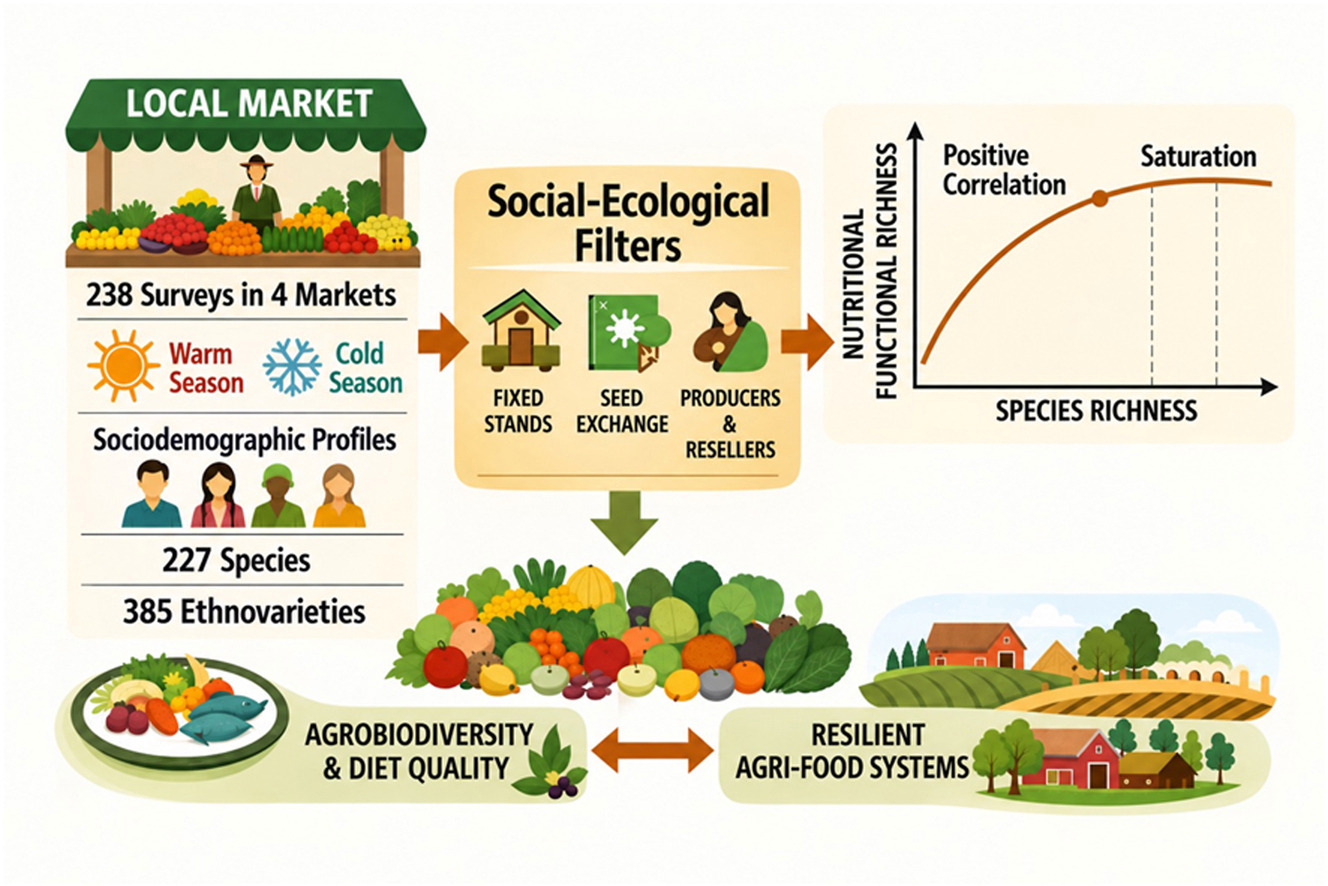
Food security and poor-quality diets are major challenges within today’s global social–ecological crises. Access to markets and more diverse diets are linked to improved nutritional quality. Previous studies have shown positive relationships between food species richness and nutritional functional diversity (NFD), a measure of the variety of nutritional traits present across food species. These studies also suggest that considering social–ecological filters may provide a more comprehensive understanding of agrobiodiversity and nutritional traits. However, little is known about how these filters shape both taxonomic and nutritional functional diversity in local markets. To investigate this question, 238 ethnobotanical surveys were conducted with vendors from four local markets in southern Chile during two different seasons (warm and cold). For each vendor, sociodemographic profiles, agrobiodiversity (plants and fungi), and nutritional functional diversity’s index was characterized. In total, 227 species and 385 ethnovarieties were reported. A positive relationship between species richness and nutritional functional richness was found, which saturated at high species numbers due to redundancy in nutritional functional traits. Generalized linear mixed models show that having a fixed stand in the market, participating in seed exchanges, and different production and sales orientations (e.g., resellers, producers, etc.) were the most supported social–ecological filters that selectively increase or decrease plant/fungal species, thereby influencing their nutritional functional traits in local markets. The opportunities for adapting this methodology to different contexts are discussed, alongside a better understanding of how social-ecological dynamics in local markets influence agrobiodiversity and people’s diets. This becomes particularly important for the process of redesigning a more resilient agri-food system in the context of global change.
Información
2026
Artículo
local_offer Líneas de acción