Livelihood vulnerability to climate variability in the Southern Andes: an index-based spatial assessment
Abstract
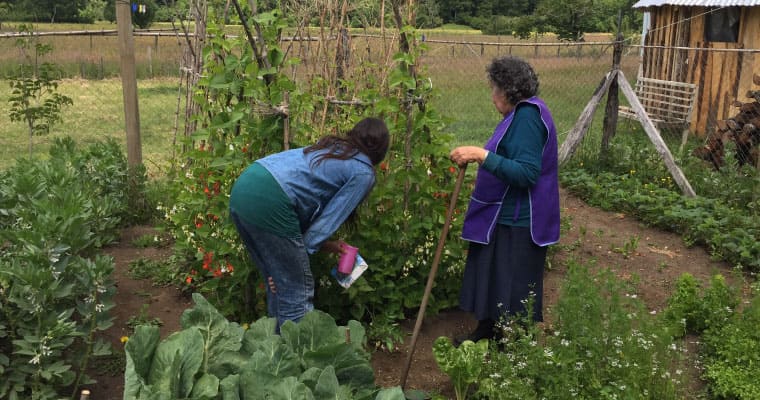
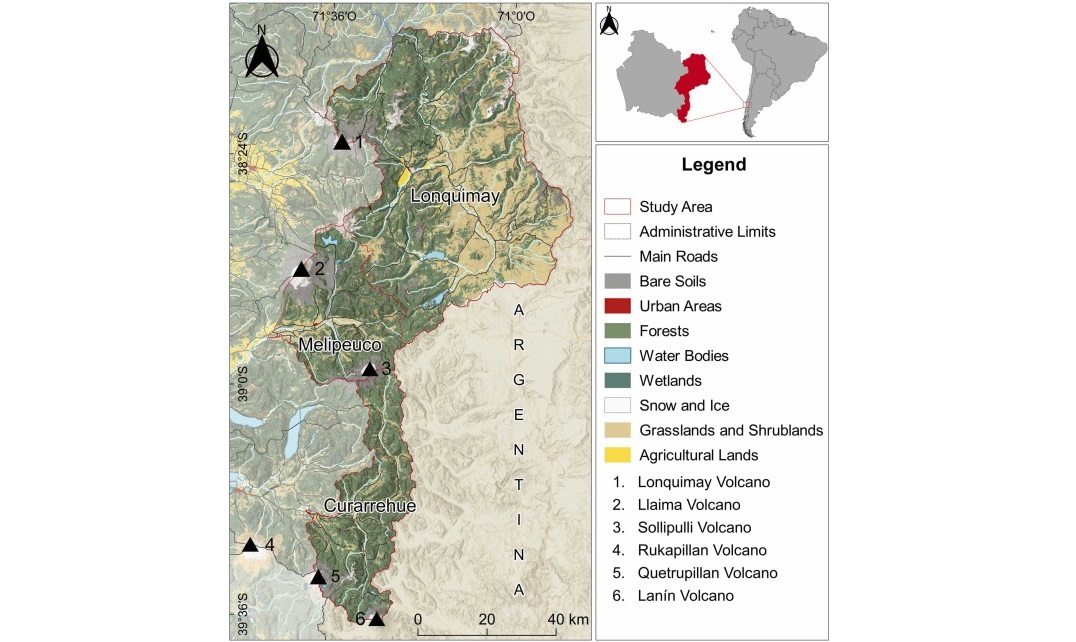
Mountain social-ecological systems are among the most exposed to climate variability, particularly those supported by small-scale farming. In the Southern Andes, Indigenous and Local Communities sustain complex farming systems integrating biocultural practices such as diversified homegardens, non-timber forest-product gathering, and transhumant herding. This study assesses the social-ecological vulnerability of 769 small-scale farming households across the Pehuenche Mountain Range, a Globally Important Agricultural Heritage System (GIAHS) in the southern Andes of Chile. We used the Livelihood Vulnerability Index (LVI), adapted to the IPCC framework, integrating 18 indicators of exposure, sensitivity, and adaptive capacity, weighted through entropybased (objective) and expert-based (subjective) methods. The global LVI averaged 0.25 (range: − 0.05 to 0.43); exposure (mean = 0.20) and sensitivity (mean = 0.13) acted as risk factors (r = 0.62 and 0.69, respectively), while adaptive capacity was the weakest dimension (mean = 0.12) and the main mitigating factor (r = − 0.82). Households with stronger human and social capital exhibited lower vulnerability, particularly through Indigenous and Local Knowledge (r = 0.76 with adaptive capacity; r = − 0.77 with sensitivity), agroecological practices, and community participation. Moran’s I and Local Indicators of Spatial Association identified significant clustering of adaptive capacity drivers (I = 0.26–0.36), with high-capacity clusters in Curarrehue and Melipeuco and low-capacity clusters in Lonquimay, where low crop diversity and reduced seed autonomy concentrate higher vulnerability. Our findings highlight the critical role of social and human assets in shaping adaptive capacity and provide an empirical basis for territorially grounded adaptation strategies in mountain socialecological systems of the Global South.
Información
2026
Artículo
Carla Marchant
carla.marchant@uach.cl
local_offer Líneas de acción